

The widespread adoption of Artificial Intelligence across high-stakes environments—particularly in learning, assessment, and critical enterprise systems—demands a proactive and formalized approach to risk governance. For ExcelSoft Technologies Co. LLC, a leader in vertical SaaS solutions leveraging AI for educational and business outcomes, maintaining absolute trust is paramount. This brief outline the AI Integrity Framework (AIF), a strategic, cyclical governance model designed to proactively identify, assess, and mitigate risks associated with bias, fairness, transparency, and data privacy across all AI-driven platforms, such as SARAS and EasyProctor. This framework moves beyond simple compliance to establish a competitive edge rooted in ethical deployment and verifiable accountability.
1. The Critical Need for a Trust-Centric AIF
AI solutions, while transformative, introduce unique and complex risks:
Algorithmic Bias in Assessment: Unfair or biased outcomes in AI-driven proctoring or scoring can severely impact a student’s future or an employee's career progression, leading to reputational and legal threats.
Data Privacy and Confidentiality: Handling sensitive learner and enterprise data requires strict adherence to global privacy standards (e.g., GDPR, local UAE regulations).
Systemic Instability: Unforeseen errors in high-scale, mission-critical SaaS platforms can cause significant operational disruptions.
A reactive stance is insufficient. Our AI Integrity Framework (AIF) is built on the global foundations of standards like ISO/IEC 42001 and adapted for the high-stakes world of EdTech and enterprise SaaS.
2. The ExcelSoft AI Integrity Framework (AIF) Cycle
The AIF is a continuous loop ensuring responsible development, deployment, and operation of AI models embedded in ExcelSoft products.

 Algorithmic Bias in Assessment
- Data Privacy and Confidentiality
- Systemic Instability
- Robustness Testing
- Privacy Impact Analysis

This brief outline the AI Integrity Framework (AIF), a strategic, cyclical governance model designed to proactively identify, assess, and mitigate risks associated with bias, fairness, transparency, and data privacy across all AI-driven platforms, such as SARAS and EasyProctor. This framework moves beyond simple compliance to establish a competitive edge rooted in ethical deployment and verifiable accountability.
Phase 1: Define Scope, Context, and Integrity Criteria
This foundational phase initiates the AIF cycle by meticulously defining the boundaries, purpose, and stakeholders for each AI application, such as EasyProctor’s gaze detection model or SARAS’s personalized recommendation engine. This process is critical for establishing the specific risk context for every model.
Key Actions in Phase 1:
Meticulously define the boundaries, purpose, and stakeholders for each AI application.
Focus on mission-critical platforms and data classification.
Address internal factors (e.g., MLOps maturity) and external factors (e.g., regulatory landscapes and regional assessment standards).
Establish the non-negotiable Integrity Criteria for Fairness, Robustness, Transparency, and Accountability (F-R-T-A).
Define specific metrics like bias audit frequency and model explainability thresholds.
By setting these standards at the outset, ExcelSoft proactively embeds responsible AI principles into the design and scope of its technology, moving beyond simple compliance to guarantee trusted outcomes.
Phase 2: Integrity & Risk Assessment
This phase involves systematically assessing identified risks against the defined Integrity Criteria.
Bias Audits: Proactively test models across demographic and contextual subsets to detect and quantify unfair treatment in scoring or proctoring flags.
Robustness Testing: Simulate adversarial attacks or data drift to ensure model stability and prevent operational failure during high-stakes exams.
Privacy Impact Analysis (PIA): Validate that training data is anonymized and compliant, and that inference data handling meets all contractual and regulatory requirements.
Phase 3: Risk Treatment and Control Implementation
For all unacceptable risks identified, specific controls must be implemented:
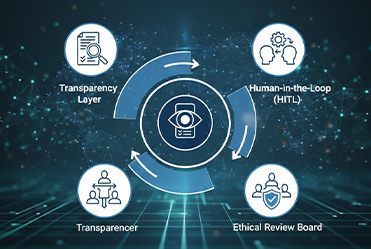
Transparency Layer: Develop simplified, user-facing explanations for AI-driven decisions (e.g., clearly stating why a proctoring flag was raised).
Human-in-the-Loop (HITL): Mandate human review for all high-severity decisions (e.g., final disqualification in an assessment, critical resource allocation in an ERP system).
Ethical Review Board: Establish an internal governance body to oversee complex ethical debates and set policy for emerging Generative AI use cases.
Phase 4: Monitoring, Review, and Continuous Improvement
Governance is continuous, not a one-time deployment. This phase closes the loop:
Real-time Model Monitoring: Track model performance and drift in the production environment. Set alerts for unexpected changes in bias metrics or performance degradation.
Post-Mortem Analysis: Review all critical incidents and high-impact decisions to refine the AIF and retrain models with targeted, de-biased data.
Annual Policy Review: Update risk definitions, governance documents, and training protocols to align with new regulatory requirements (like the rapid evolution of the EU AI Act or local mandates).
3. The ExcelSoft Competitive Advantage
By adopting the AI Integrity Framework, ExcelSoft Technologies Co. LLC transforms AI governance from a compliance overhead into a core value proposition:
1. Enhanced Client Confidence: Demonstrating verifiable F-R-T-A compliance builds deeper trust with academic, government, and corporate clients globally.
2. Operational Efficiency: Proactive risk identification reduces costly, reactive crisis management and minimizes system downtime.
3. Innovation Safety Net: A clear risk framework allows the organization to rapidly deploy new, powerful AI features—such as enhanced generative learning tools—with tested guardrails in place.
The AIF is not just about avoiding harm; it is about guaranteeing the integrity of every learning outcome and business decision powered by ExcelSoft’s technology.